VAT Registration Threshold: When You Must Register
Quick Summary: Most articles on the VAT registration threshold give you the £90,000 figure and stop, which is the least useful part of the answer. The number is easy. What catches businesses out is everything around it: the fact that the test runs on a rolling twelve months rather than your accounting year, the separate forward-look test that can force registration in a single month, the difference between the date you must notify HMRC and the date you must start charging VAT, the exception that lets some businesses stay unregistered after crossing the line, and what a late registration actually costs once HMRC backdates it. This guide works through each of those with the numbers attached.
Why £90,000 Is Only Half the Answer
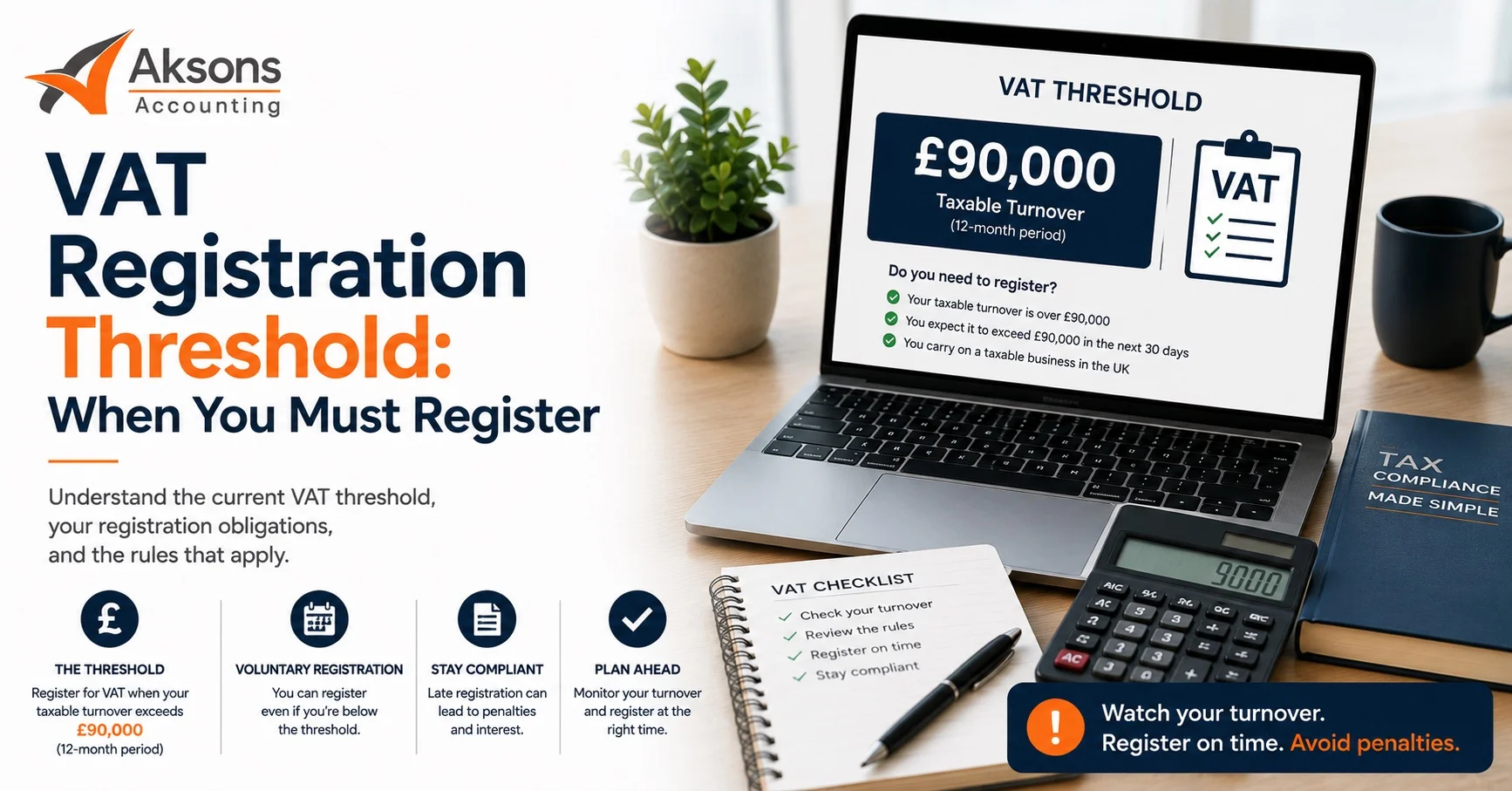
The UK VAT registration threshold is £90,000 of taxable turnover. It has been £90,000 since 1 April 2024, when it rose from £85,000, and it remains at that level for 2026/27.
That is the easy part, and it is where most guidance ends. The expensive misunderstandings happen elsewhere.
The most common one is timing. Businesses assume the threshold is measured against their accounting year or the tax year, and check once. It is neither. It is a rolling twelve-month window that moves forward at the end of every calendar month, which means the check needs running twelve times a year rather than once. A business that reviews its position only at year end can be six months late before it discovers there was ever a problem.
The second is scope. Taxable turnover is not the same as revenue, and it is not the same as profit. Zero-rated sales count towards the threshold even though no VAT is charged on them. So do construction supplies made under the reverse charge. Exempt sales do not count at all. Getting this wrong in either direction leads to registering unnecessarily or missing the deadline entirely.
The 2026/27 VAT Thresholds at a Glance
| Threshold | Amount | What it does |
| Registration threshold | £90,000 | Registration becomes compulsory once taxable turnover exceeds this |
| Deregistration threshold | £88,000 | You may apply to cancel registration if turnover falls below this |
| Flat Rate Scheme, joining limit | £150,000 (excluding VAT) | Maximum expected taxable turnover to join |
| Flat Rate Scheme, exit limit | £230,000 (including VAT) | You must leave the scheme above this |
| Cash Accounting Scheme | £1.35 million | Maximum taxable turnover to join |
| Annual Accounting Scheme | £1.35 million | Maximum taxable turnover to join |
Both the registration and deregistration thresholds have been frozen since April 2024. Because they are not indexed to inflation, more businesses cross the line each year without their real-terms turnover having grown at all.
What Counts as Taxable Turnover
| Type of supply | Counts towards £90,000? |
| Standard-rated sales (20%) | Yes |
| Reduced-rated sales (5%) | Yes |
| Zero-rated sales (0%), books, most food, children’s clothing | Yes |
| Construction services under the domestic reverse charge | Yes |
| Exempt supplies, most insurance, finance, some education, residential rent | No |
| Sales outside the scope of UK VAT | No |
| Money you receive that is not consideration for a supply | No |
The two rows in bold are where businesses most often go wrong. A zero-rated business charges no VAT to anyone and still has to register once it passes £90,000. A CIS subcontractor operating under the reverse charge does not add VAT to its invoices, but the value of those supplies still counts towards its own registration threshold.
The Two Tests That Trigger Registration
There are two separate tests. Either one, on its own, makes registration compulsory.
The Backward Look: Rolling Twelve Months
At the end of every calendar month, add up your taxable turnover for the previous twelve months. If the total exceeds £90,000, you must register.
The window slides forward each month. One month is added at the front and one drops off the back.
Working example. Your taxable turnover for the twelve months to 30 April 2026 is £88,000. In May 2026 you invoice £5,000. May 2025, which now drops out of the window, was £2,000.
£88,000 + £5,000 − £2,000 = £91,000
You have crossed the threshold as at 31 May 2026, even though your turnover only rose by £3,000 that month. The trigger is the rolling total, not the monthly figure.
The Forward Look: The Next 30 Days Alone
You must also register if, at any point, you have reasonable grounds to believe your taxable turnover will exceed £90,000 in the next 30 days on its own.
This test ignores your history entirely. A business with £20,000 of turnover in the past year that signs a £95,000 contract deliverable within the month must register immediately.
The forward-look test is the one that catches businesses out on a single large project. If you are negotiating a contract that would breach the threshold in one go, take advice before you sign rather than after.
The Exception: Crossing the Line without Registering
Crossing the threshold does not automatically mean you must register. If the breach is genuinely temporary, you can apply to HMRC for an exception from registration.
To succeed, you must be able to demonstrate that your taxable turnover for the next twelve months will not exceed the deregistration threshold of £88,000. A one-off contract, an unusual bulk order, or a seasonal spike that will not repeat are the sorts of circumstances this exists for.
You must apply, with evidence. It is not automatic and it is not something you can simply assume applies.
Your Deadline and Your Effective Date
These are two different dates, and confusing them is a common and costly error.
| | Backward look | Forward look |
| Notify HMRC by | 30 days after the end of the month you crossed | The end of the 30-day period |
| Registration takes effect from | The first day of the second month after you crossed | The date you first had reasonable grounds to expect the breach |
| Charge VAT from | Your effective date of registration | Your effective date of registration |
Continuing the example above. You crossed the threshold at the end of May 2026. You must notify HMRC by 30 June 2026. Your effective date of registration is 1 July 2026, and that is the date from which VAT must be charged on your sales.
That gap matters commercially. It gives you roughly a month to update your pricing, tell customers, get your invoicing set up and decide which VAT scheme to operate. Businesses that leave the notification to the last day lose all of that breathing room.
One practical point: your VAT number can take a few weeks to arrive, but your obligation to account for VAT starts on your effective date regardless. The standard approach is to raise invoices at a VAT-inclusive value in the interim and reissue proper VAT invoices once the number comes through.
What Late Registration Actually Costs
Late registration produces two separate costs that compound.
First, the backdated VAT. HMRC backdates your registration to the date you should have registered. You then owe VAT on all taxable sales made since that date, whether or not you charged it to your customers. If your customers are VAT-registered you may be able to issue VAT-only invoices and recover it from them. If they are consumers, the liability falls on you.
Because you never added VAT on top, HMRC treats what you received as VAT-inclusive. For standard-rated sales, the output tax is the gross figure divided by six, not multiplied by 20%.
A concrete example. You should have registered from 1 July 2025 but did not do so until July 2026. Standard-rated sales in that period were £120,000, and you incurred £3,000 of recoverable input VAT.
- Output VAT: £120,000 ÷ 6 = £20,000
- Less input VAT: £3,000
- Net VAT owed: £17,000
That £17,000 comes straight out of margin you have already spent.
Second, the failure-to-notify penalty. This is charged under Schedule 41 of the Finance Act 2008, as a percentage of the potential lost revenue, broadly the net VAT above.
| Behaviour | Maximum penalty |
| Careless (non-deliberate) | 30% of potential lost revenue |
| Deliberate but not concealed | 70% of potential lost revenue |
| Deliberate and concealed | 100% of potential lost revenue |
Penalties can be reduced substantially depending on whether the disclosure is unprompted or prompted, and on how fully you cooperate. The practical lesson is straightforward: if you suspect you have registered late, disclosing it before HMRC finds it yourself is worth real money.
Voluntary Registration: When It Makes Commercial Sense
Registration is available below the threshold, and a substantial share of registered businesses are there by choice rather than obligation.
It usually makes sense when:
- Your customers are predominantly VAT-registered businesses, so the VAT you add costs them nothing and they reclaim it
- You have significant input VAT to recover — equipment, stock, materials, professional fees
- You make zero-rated supplies, which means you charge nothing but reclaim everything, producing a regular repayment position
- You want to avoid signalling to larger clients that your turnover is under £90,000
It usually does not when:
- You sell to consumers, who cannot reclaim VAT, so registering means either a 20% price rise or a 20% cut to your own margin
- Your input VAT is minimal, which is typical of service businesses with low overheads
- You are unlikely to approach the threshold and the compliance burden outweighs the recovery
Registering also brings you into Making Tax Digital for VAT, which applies to every VAT-registered business regardless of turnover. Digital record keeping and software-based submission are not optional.
Choosing a VAT Scheme Once Registered
| Scheme | Eligibility | What it does | Main watch-out |
| Standard accounting | Any registered business | Output VAT less input VAT each quarter | Most record keeping, but full input recovery |
| Flat Rate Scheme | Expected taxable turnover £150,000 or less excluding VAT | Pay a fixed percentage of gross turnover; no input recovery | The limited cost trader rule |
| Cash Accounting | Taxable turnover £1.35m or less | Account for VAT when money moves, not when invoiced | Cannot be combined with Flat Rate |
| Annual Accounting | Taxable turnover £1.35m or less | One return a year with interim instalments | Reconciliation happens only once |
The Flat Rate Scheme deserves particular care. If your VAT-inclusive spend on goods is less than 2% of turnover, or less than £1,000 a year, you are a limited cost trader and must use a flat rate of 16.5% regardless of your sector. At 16.5% of VAT-inclusive turnover, and with no input VAT recovery, the scheme rarely pays for those businesses. Most service businesses with low material costs fall into this category.
There is a one percentage point discount on your flat rate for the first year of registration, which applies to the limited cost rate as well. It is worth factoring in, but it should not be the deciding argument.
Cash accounting is often the more valuable choice for small businesses, because it means you are not paying HMRC VAT on invoices your customers have not yet settled.
Traps That Catch Small Businesses
One person, one threshold: If you run two sole trader activities, their turnover is combined. You do not get £90,000 for each. HMRC assesses your total taxable turnover as an individual.
Splitting a business to stay under: Artificially separating one business into two to keep both below the threshold is disaggregation, and HMRC has specific powers to direct that the businesses be treated as one, with the registration backdated.
Reverse charge supplies still count: CIS subcontractors under the domestic reverse charge add no VAT to their invoices but must still include those supplies in their own threshold calculation.
Landlord income is not uniform: Residential rent is exempt and does not count. Commercial property income may be exempt or, where an option to tax has been made, standard-rated and counting in full.
Pass-through costs where you act as principal: If you buy something and resell it in your own name rather than acting purely as an agent, the full amount is your taxable turnover, not just your margin.
Checking once a year. The single most expensive habit in this entire guide.
Putting It Into Practice: A Quick Checklist
- Calculated your rolling twelve-month taxable turnover as at the end of last month
- Set a recurring monthly reminder to repeat that calculation
- Separated taxable supplies from exempt supplies in your bookkeeping
- Confirmed that zero-rated and reverse charge supplies are included in the total
- Combined turnover across all your sole trader activities, if you have more than one
- Checked whether any contract in the pipeline would breach the threshold within 30 days on its own
- Identified the notification deadline and effective date if you have already crossed
- Considered applying for an exception if the breach is genuinely one-off
- Modelled voluntary registration if most of your customers are VAT-registered
- Compared standard accounting against the Flat Rate Scheme using your own figures, including the limited cost trader test
- Confirmed your bookkeeping software is Making Tax Digital compatible
Key Takeaways
- The VAT registration threshold is £90,000 of taxable turnover for 2026/27, unchanged since April 2024, with a deregistration threshold of £88,000.
- The test runs on a rolling twelve-month basis and must be checked at the end of every calendar month, not annually.
- A separate forward-look test forces registration if you expect to exceed £90,000 in the next 30 days alone.
- Zero-rated sales and construction reverse charge supplies count towards the threshold; exempt supplies do not.
- After crossing, you have 30 days from the end of the month to notify HMRC, and registration takes effect from the first day of the second month.
- A genuinely temporary breach may qualify for an exception, but you must apply and evidence it.
- Late registration means backdated VAT calculated as gross sales divided by six, plus a failure-to-notify penalty of up to 100% of the lost revenue.
Frequently Asked Questions
What is the VAT registration threshold for 2026/27?
£90,000 of taxable turnover. It has been at that level since 1 April 2024 and remains unchanged for 2026/27. The deregistration threshold is £88,000.
Is the threshold measured against the tax year?
No, and this is the most common misunderstanding. It is a rolling twelve-month period that moves forward at the end of every calendar month. It does not reset on 6 April or at your accounting year end.
Do zero-rated sales count towards the threshold?
Yes. Zero-rated supplies are taxable at 0%, so they count in full. Only exempt supplies, such as most insurance, finance and residential rent, are excluded.
What happens if I register late?
HMRC backdates your registration and you owe VAT on all taxable sales from that date, even if you never charged it. Because the amounts you received are treated as VAT-inclusive, output tax is your gross sales divided by six. A failure-to-notify penalty of up to 100% of the lost revenue can be added on top, though disclosing before HMRC finds it reduces this significantly.
Can I register for VAT voluntarily if I am below £90,000?
Yes. It usually makes sense if your customers are VAT-registered businesses, if you have significant input VAT to reclaim, or if you make zero-rated supplies. It rarely makes sense if you sell to consumers, because you either raise prices by 20% or absorb the cost.
Can I cancel my registration if turnover falls?
You can apply to deregister if your taxable turnover drops below £88,000 and you expect it to stay there. Deregistration is not automatic and there may be VAT to account for on stock and assets you still hold at that point.
Conclusion
The VAT registration threshold looks like a single number, but in practice it is a monthly monitoring obligation with two separate trigger tests, two distinct deadlines, and a penalty regime that treats “I did not realise” as carelessness rather than an excuse. The businesses that get caught are almost never the ones deliberately avoiding registration. They are the ones who checked once a year, or who did not realise their zero-rated or reverse charge income counted.
If your turnover is anywhere in the £70,000 to £90,000 range, the sensible move is to work out exactly where your rolling twelve-month total sits now, rather than discovering it retrospectively. At Aksons Accounting we handle VAT registration, scheme selection and quarterly returns as part of our monthly service. Send us your last twelve months of sales figures and we will tell you where you stand and what, if anything, needs doing.