Learn the key ICO responsibilities for UK businesses in 2026, including ICO registration, GDPR compliance, data breach rules, subject access requests, CCTV obligations, marketing consent, and SME data protection risks.
Clear accounting and IR35 support with straightforward monthly pricing from £95.00 per month
Complete company accounts, tax, and ongoing support with fixed monthly pricing from £95.00 per month
Simple accounting and tax support to keep your records organised from £40.00 per month
CIS tax returns handled accurately and submitted on time from £270 per month
Rental income tracking and tax reporting with clear monthly support from £33.00 per month
Start your business with free company formation and ongoing accounting support
Stay compliant with Making Tax Digital and avoid last-minute issues with clear, ongoing support
Get your self assessment tax return completed accurately and on time without the usual stress
Switch accountant without disruption. We handle the full process so nothing is missed


Clear accounting and IR35 support with straightforward monthly pricing from £95.00 per month
Complete company accounts, tax, and ongoing support with fixed monthly pricing from £95.00 per month
Simple accounting and tax support to keep your records organised from £40.00 per month
CIS tax returns handled accurately and submitted on time from £270 per month
Rental income tracking and tax reporting with clear monthly support from £33.00 per month
Start your business with free company formation and ongoing accounting support
Stay compliant with Making Tax Digital and avoid last-minute issues with clear, ongoing support
Get your self assessment tax return completed accurately and on time without the usual stress
Switch accountant without disruption. We handle the full process so nothing is missed


May 25, 2026
akson
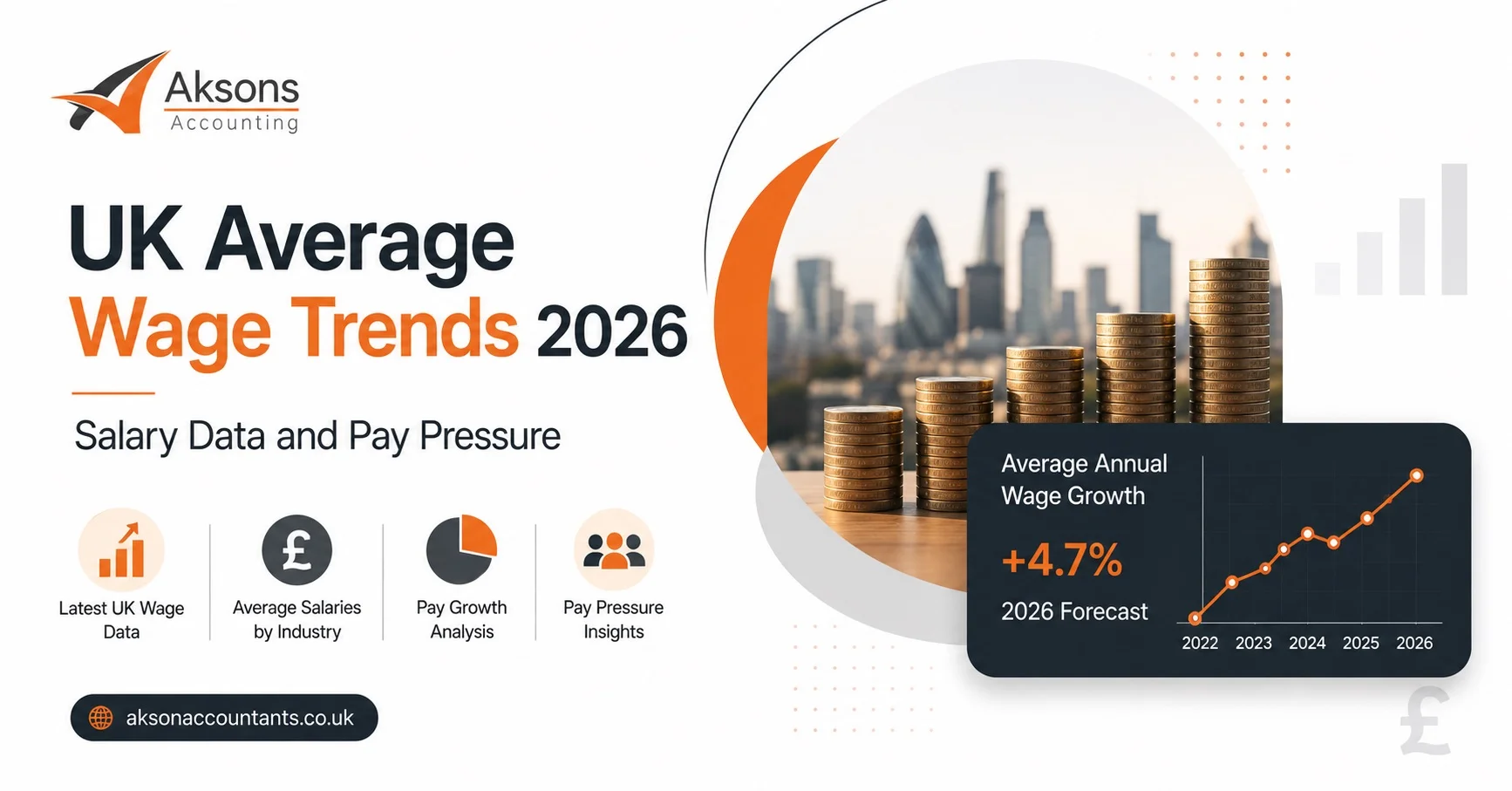
UK average wage trends in 2026 do not tell a simple story. Pay is still rising, but the pace is uneven, the pressure is still real, and the gap between headline numbers and lived experience remains wide.
The latest published official earnings figures put the median full time salary at £39,039. That was a 4.3 percent rise, with real wage growth at 1.1 percent after inflation. The same release also showed that low paid jobs fell to a record low of 2.5 percent of the workforce, high paid jobs rose to 23.2 percent, and the top 10 percent of full time earners needed to make nearly £77,000 a year.
That is the most honest way to read the market in 2026. Wages are moving up, but not quickly enough to make every household feel secure. A modest rise in real terms is still a rise, but it does not undo several years of higher costs, tighter budgets, and more expensive borrowing. That is why the headline can look healthier than the reality.
The other part of the story is the bottom end of the market. From April 2026, the national minimum wage rose to £12.71 an hour for workers aged 21 and over, £10.85 for workers aged 18 to 20, and £8 for younger workers and apprentices. The government said the change would affect about 2.4 million workers.
That matters because wage trends are not just about higher earners. When the wage floor moves, it pulls up pay expectations across retail, hospitality, care, logistics, and other labour heavy sectors. Employers often feel that pressure twice. First in entry level wages. Then again in the salaries of supervisors, team leaders, and experienced staff who expect the gap to remain meaningful.
For businesses, that creates a simple but uncomfortable point. Pay strategy is no longer a yearly admin exercise. It is part of margins, recruitment, retention, and pricing. Ignore it for too long and the correction comes later in a more expensive form.
“Average wage” is useful, but only up to a point.
A national figure hides too much. It blends together London salaries, regional pay, part time work, high skill professional roles, lower paid service jobs, and very different household cost structures. A salary that looks acceptable on paper can feel tight in one area and generous in another.
That is why the most useful reading of UK average wage trends in 2026 is not “what is the number”, but “who is it helping”.
The latest data show that wage growth is still real, but not evenly distributed. The full time gender pay gap narrowed to 6.7 percent in the latest release, which shows some movement, but also reminds us that average earnings are still split unevenly across the workforce.
The UK does not have one wage market. It has several.
London remains the highest paying region, but it also has the steepest living costs. Outside London, salaries are generally lower, but the comparison is incomplete without housing, commuting, and day to day expenses. A wage that looks weaker in a national chart may still go further locally.
That is why the same salary can mean different things depending on where someone lives. A worker in London may need a much higher nominal income just to hold the same standard of living as a worker in a lower cost region. In practice, regional wage trends matter as much as the national figure, sometimes more.
For employers, this creates a practical problem. If you recruit nationally, you compete on a wider salary range. If you recruit locally, you need to understand local market expectations, not just a national benchmark.
One of the most telling pieces of current context is housing. In England, the median home cost £300,000 and that was 7.6 times the median annual full time salary of £39,300. That ratio had improved from 7.8 the year before, but it still shows how far wages have to stretch in order to meet basic asset prices. London remains the least affordable region, with a house price to income ratio of 10.6.
That is why people often say wages do not feel like they are improving, even when official data shows growth. Salary growth and housing affordability are moving in different directions. The wage line is improving. The cost base is still demanding too much.
This is where wage trends become useful.
A business does not need to overreact to every headline. It does need to know whether its pay structure is still workable.
The sensible questions are not glamorous ones. Are your salary bands still competitive. Are your junior roles too close to your senior roles. Are you paying enough to keep people. Are you underpricing your work because payroll has moved faster than your rate card.
That is the point where wage trends become a financial planning issue, not just a staffing issue.
At Aksons Accounting Services Ltd, this kind of pressure is exactly why payroll planning, bookkeeping accuracy, tax awareness, and cash flow discipline need to sit together. A business that does not understand its wage burden properly usually ends up making decisions late, and late decisions cost more.
Workers should read the 2026 wage picture with some discipline.
The market is not flat. It is not broken either. It is uneven. Higher paid roles are still pulling away from low paid work, the minimum wage has risen again, and real wages are finally moving forward in small steps. But the gains are still modest once inflation and living costs are folded in.
That means salary negotiations should be based on role, sector, region, and responsibility, not just on a national average. A job offer needs to be read in context. So does a pay rise. The question is not only whether pay increased. The question is whether it increased enough to matter after costs.
A clean way to read the market is this.
The headline wage figure is up. Real wages are positive, but only slightly. The wage floor has moved higher again. High paid roles continue to pull away. Regional and housing pressure still distort how far pay goes.
That is not a boom. It is not a crisis either. It is a market under pressure, with some recovery, but without much room for complacency.
For business owners, that means tighter pay planning. For workers, it means comparing offers carefully. For advisers, it means treating wage data as part of wider financial decision making, not as a statistic to quote and move on from.
UK average wage trends in 2026 are best understood as slow progress under pressure.
The latest figures show median full time pay at £39,039, real wage growth at 1.1 percent, low paid jobs at a record low of 2.5 percent, and the top 10 percent of full time earners close to £77,000. At the same time, the minimum wage has risen to £12.71 an hour for workers aged 21 and over, and housing remains far out of reach relative to income in many places.
That combination tells you what matters. Wages are improving, but the improvement is not broad enough or fast enough to make the pressure disappear.
For businesses, the next move is to plan with those numbers in mind. For workers, it is to judge salary offers against the full cost of living, not the headline alone. And for anyone managing a UK business, Aksons Accounting Services Ltd can help keep payroll, bookkeeping, and tax planning aligned with the numbers that actually shape decisions.
What is the UK average wage in 2026?
The latest published official figure puts the median full time salary at £39,039.
Are UK wages still rising in 2026?
Yes. The latest published figures show wage growth of 4.3 percent, with real wage growth at 1.1 percent after inflation.
What is the 2026 minimum wage in the UK?
From April 2026, the national minimum wage is £12.71 an hour for workers aged 21 and over, £10.85 for ages 18 to 20, and £8 for younger workers and apprentices.
Why does the average wage feel lower than the headline number?
Because housing, rent, transport, food, and borrowing costs still absorb a large share of income, especially in higher cost regions.
Which workers benefit most from the 2026 wage changes?
Lower paid workers gain most directly from the minimum wage increase, while middle and higher earners are more affected by real wage growth and sector specific pay pressure.
Learn the key ICO responsibilities for UK businesses in 2026, including ICO registration, GDPR compliance, data breach rules, subject access requests, CCTV obligations, marketing consent, and SME data protection risks.
A 2026 guide to UK average wage trends, including the latest salary figures, minimum wage changes, real pay growth, regional pressure, and what the numbers mean for businesses and workers.
From April 2026, HMRC’s Making Tax Digital rules will begin changing how sole traders and landlords report income tax. For many businesses, this is not just another compliance update. It changes the rhythm of financial management itself.

Choosing between sole trader and limited company status sets the tax you pay, the paperwork you file, and the personal risk you carry. The right answer depends on your profits, your sector, and your appetite for admin.