A complete guide to the Construction Industry Scheme: deduction rates, registration, gross payment status, monthly returns and the April 2026 CIS changes.

Clear accounting and IR35 support with straightforward monthly pricing from £95.00 per month
Complete company accounts, tax, and ongoing support with fixed monthly pricing from £95.00 per month
Simple accounting and tax support to keep your records organised from £40.00 per month
CIS tax returns handled accurately and submitted on time from £270 per month
Rental income tracking and tax reporting with clear monthly support from £33.00 per month
Start your business with free company formation and ongoing accounting support
Stay compliant with Making Tax Digital and avoid last-minute issues with clear, ongoing support
Get your self assessment tax return completed accurately and on time without the usual stress
Switch accountant without disruption. We handle the full process so nothing is missed
Clear accounting and IR35 support with straightforward monthly pricing from £95.00 per month
Complete company accounts, tax, and ongoing support with fixed monthly pricing from £95.00 per month
Simple accounting and tax support to keep your records organised from £40.00 per month
CIS tax returns handled accurately and submitted on time from £270 per month
Rental income tracking and tax reporting with clear monthly support from £33.00 per month
Start your business with free company formation and ongoing accounting support
Stay compliant with Making Tax Digital and avoid last-minute issues with clear, ongoing support
Get your self assessment tax return completed accurately and on time without the usual stress
Switch accountant without disruption. We handle the full process so nothing is missed

June 15, 2026
Aksons
Most discussions about Making Tax Digital focus on software.
Which software should you buy?
How often will you submit information?
When do the new rules start?
Those questions matter.
But they are not the most important questions.
The more important issue is that Making Tax Digital for Income Tax represents one of the biggest structural changes to sole trader tax administration in decades.
For years, many self employed individuals have operated on a familiar cycle.
Business activity happens throughout the year.
Records accumulate.
Receipts disappear into drawers.
Bank statements are downloaded in January.
An accountant reconstructs the year.
A tax return is submitted.
The process is often inefficient, but it remains familiar.
Making Tax Digital challenges that model entirely.
HMRC’s objective is not simply to digitise tax submissions. The wider goal is to create a reporting environment where business information is captured earlier, maintained more consistently, and submitted throughout the year rather than retrospectively assembled at year end.
For sole traders, freelancers, consultants, landlords, and other self employed professionals, this is not merely a compliance update.
It is an operational shift.
And like most operational shifts, the businesses that prepare early will experience relatively little disruption. The businesses that delay adaptation until deadlines arrive are likely to discover that the challenge extends far beyond installing accounting software.
To understand Making Tax Digital, it helps to understand the problem HMRC is trying to solve.
The existing Self Assessment system relies heavily on retrospective reporting.
Income is earned.
Expenses occur.
Records are created.
Then many months later, information is consolidated and submitted.
From HMRC’s perspective, that model creates several problems.
By the time information reaches HMRC, it may relate to activity that occurred many months earlier.
This delay limits visibility and reduces opportunities to identify errors early.
Many sole traders maintain excellent records.
Many do not.
The quality of reporting often depends on bookkeeping habits rather than systematic processes.
Where record keeping is inconsistent, errors become more likely.
Not necessarily because taxpayers are dishonest.
Often because information is incomplete, missing, duplicated, or reconstructed long after the original transaction occurred.
Making Tax Digital is designed to reduce those weaknesses by encouraging continuous record keeping throughout the year.
Whether it fully achieves that objective remains open to debate.
But the direction of travel is clear.
HMRC wants fewer annual reconstruction exercises and more real time financial visibility.
One of the biggest misconceptions surrounding MTD is that it only affects larger businesses.
The reality is different.
The rules will affect a substantial portion of the UK’s self employed population.
This includes:
Many people who have comfortably managed annual Self Assessment for years will soon find themselves operating under a very different reporting framework.
For some, the adjustment will be straightforward.
For others, it will expose weaknesses that have existed for years but remained hidden because the annual filing cycle allowed those weaknesses to be corrected retrospectively.
The accounting software industry often presents MTD as a technology issue.
Choose compliant software.
Connect your accounts.
Submit your updates.
Problem solved.
That view is incomplete.
Technology rarely causes the biggest problems.
Processes do.
A sole trader with organised bookkeeping can usually adapt to new software relatively quickly.
A sole trader with inconsistent records simply digitises inconsistency.
The underlying problem remains.
That is why many businesses underestimate the transition.
They assume software adoption equals compliance readiness.
In practice, software only amplifies the quality of existing financial processes.
Good habits become easier.
Poor habits become more visible.
The businesses likely to struggle most with MTD often share similar characteristics.
Many sole traders continue using personal accounts for business activity.
While legally possible in many situations, it complicates bookkeeping significantly.
Every transaction requires interpretation.
Every expense requires validation.
Every review takes longer.
Under a more frequent reporting environment, those inefficiencies become increasingly expensive.
Business owners frequently underestimate how much financial information is lost during the year.
Small expenses disappear.
Receipts are misplaced.
Subscriptions are forgotten.
Travel costs go unrecorded.
By January, reconstruction becomes guesswork.
MTD places greater pressure on maintaining records consistently rather than retrospectively.
Spreadsheets remain useful tools.
They are not accounting systems.
Many sole traders rely heavily on spreadsheets because they appear flexible and inexpensive.
The problem is that manual systems become increasingly fragile as transaction volumes grow.
What works for twenty transactions per month often becomes unmanageable at two hundred.
The businesses adapting most successfully are not waiting for mandatory deadlines.
They are already improving:
More importantly, they are reducing dependence on year end reconstruction.
That is where the greatest long term efficiency gains often emerge.
At Aksons Accounting Services Ltd, one recurring observation across growing sole trader businesses is that revenue growth frequently outpaces financial infrastructure. The business becomes larger, transactions become more numerous, and reporting obligations become more complex, yet bookkeeping processes remain largely unchanged. Making Tax Digital is forcing many businesses to address that imbalance.
A complete guide to the Construction Industry Scheme: deduction rates, registration, gross payment status, monthly returns and the April 2026 CIS changes.

The UK VAT registration threshold is £90,000. Learn how the rolling 12-month test works, your real deadline, and what late registration actually costs.
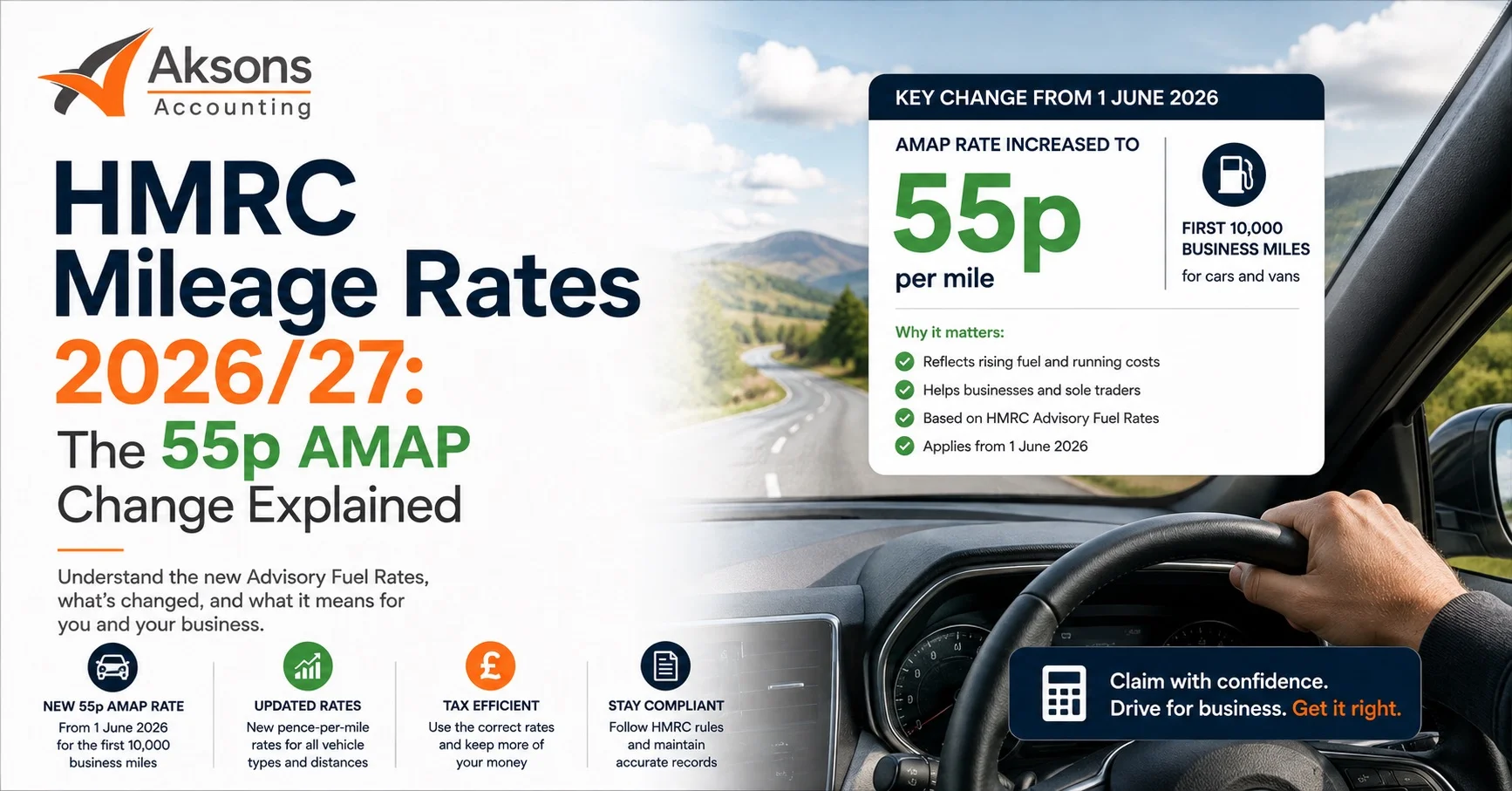
HMRC mileage rates rose to 55p per mile from 6 April 2026, the first rise in 15 years. Full rate tables, worked examples, and how to claim what you are owed.
Companies House identity verification is now a legal duty. Find your actual deadline, get your personal code, and avoid a blocked confirmation statement.
Electric vehicle tax relief for UK businesses explained: 100% first year allowances, VAT rules and 2026/27 BIK rates for company cars and sole traders.
Learn how dividends work for UK limited companies, including distributable profits, dividend tax rates, paperwork, salary vs dividends and common mistakes.
Explore the latest UK company formation statistics and discover what they mean for new business owners. Learn practical accounting, tax and compliance insights from Aksons Accounting Services Ltd.
Learn about the new HMRC rules for 2026, including digital reporting, record keeping, tax compliance, and practical steps UK businesses can take to stay compliant and improve financial management.
Learn the Child Benefit tax rates for 2026, understand the High Income Child Benefit Charge, adjusted net income, Self Assessment obligations, and practical tax planning strategies for UK families.
Discover the key takeaways from the Spring Statement 2026 and what they mean for UK businesses, sole traders, and company directors. Learn how to respond to policy changes, strengthen financial planning, and prepare for evolving compliance requirements.
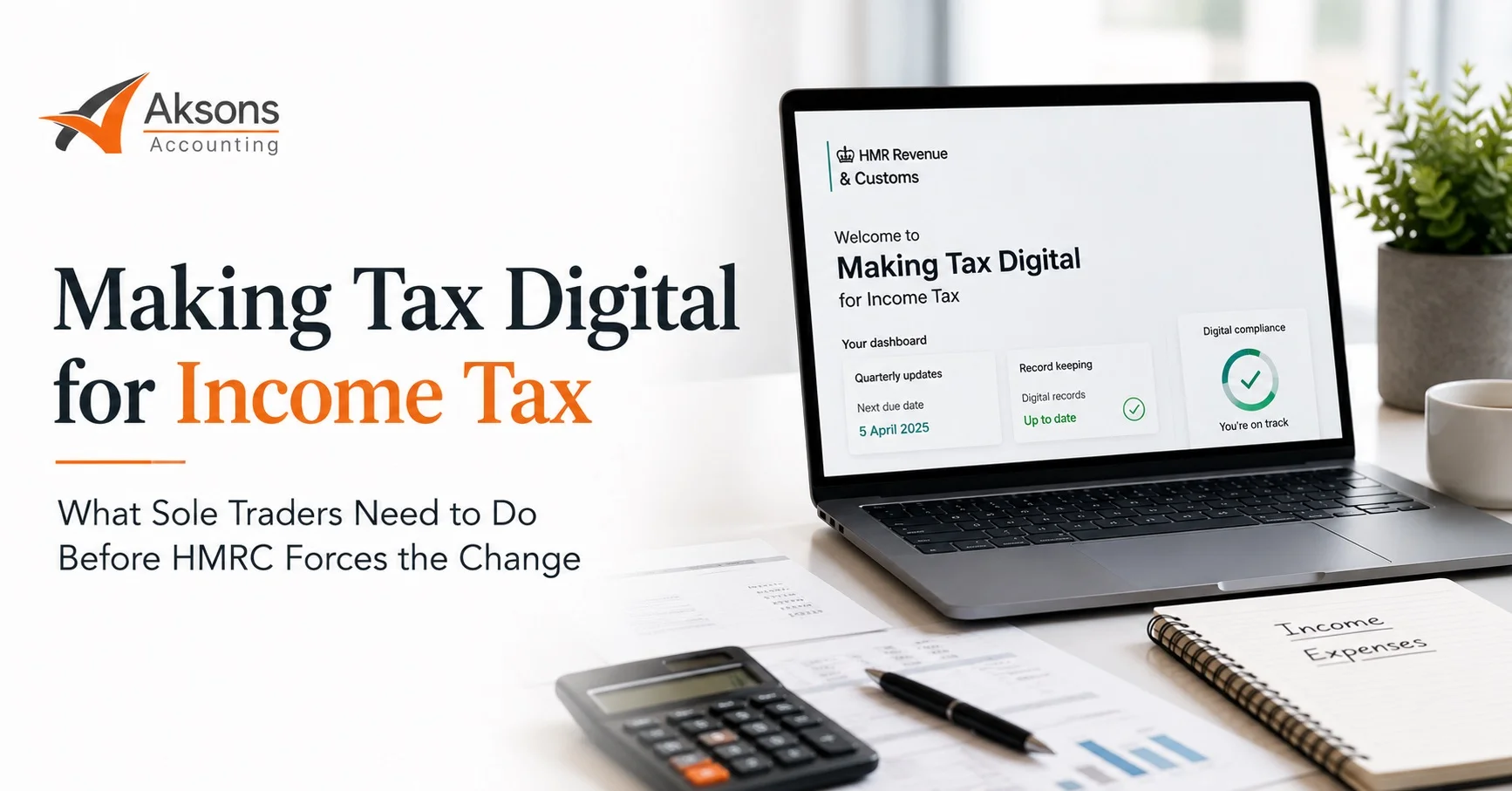
Learn how Making Tax Digital for Income Tax will affect sole traders, freelancers, and landlords. Understand quarterly reporting, compliance requirements, common challenges, and how to prepare before the new HMRC rules take effect.
Learn what the Companies House WebFiling security issue means for UK businesses, the risks of filing fraud, identity verification changes, and the steps directors can take to protect company records and strengthen compliance.
Learn how to complete your Self Assessment tax return in 2026, including deadlines, allowable expenses, payments on account, landlord income, freelancer taxes, and common HMRC filing mistakes.
Learn the latest Companies House filing fees in 2026, including confirmation statement costs, late filing penalties, company incorporation fees, and the hidden compliance risks UK businesses often overlook.
Learn the key ICO responsibilities for UK businesses in 2026, including ICO registration, GDPR compliance, data breach rules, subject access requests, CCTV obligations, marketing consent, and SME data protection risks.
A 2026 guide to UK average wage trends, including the latest salary figures, minimum wage changes, real pay growth, regional pressure, and what the numbers mean for businesses and workers.
From April 2026, HMRC’s Making Tax Digital rules will begin changing how sole traders and landlords report income tax. For many businesses, this is not just another compliance update. It changes the rhythm of financial management itself.
Choosing between sole trader and limited company status sets the tax you pay, the paperwork you file, and the personal risk you carry. The right answer depends on your profits, your sector, and your appetite for admin.