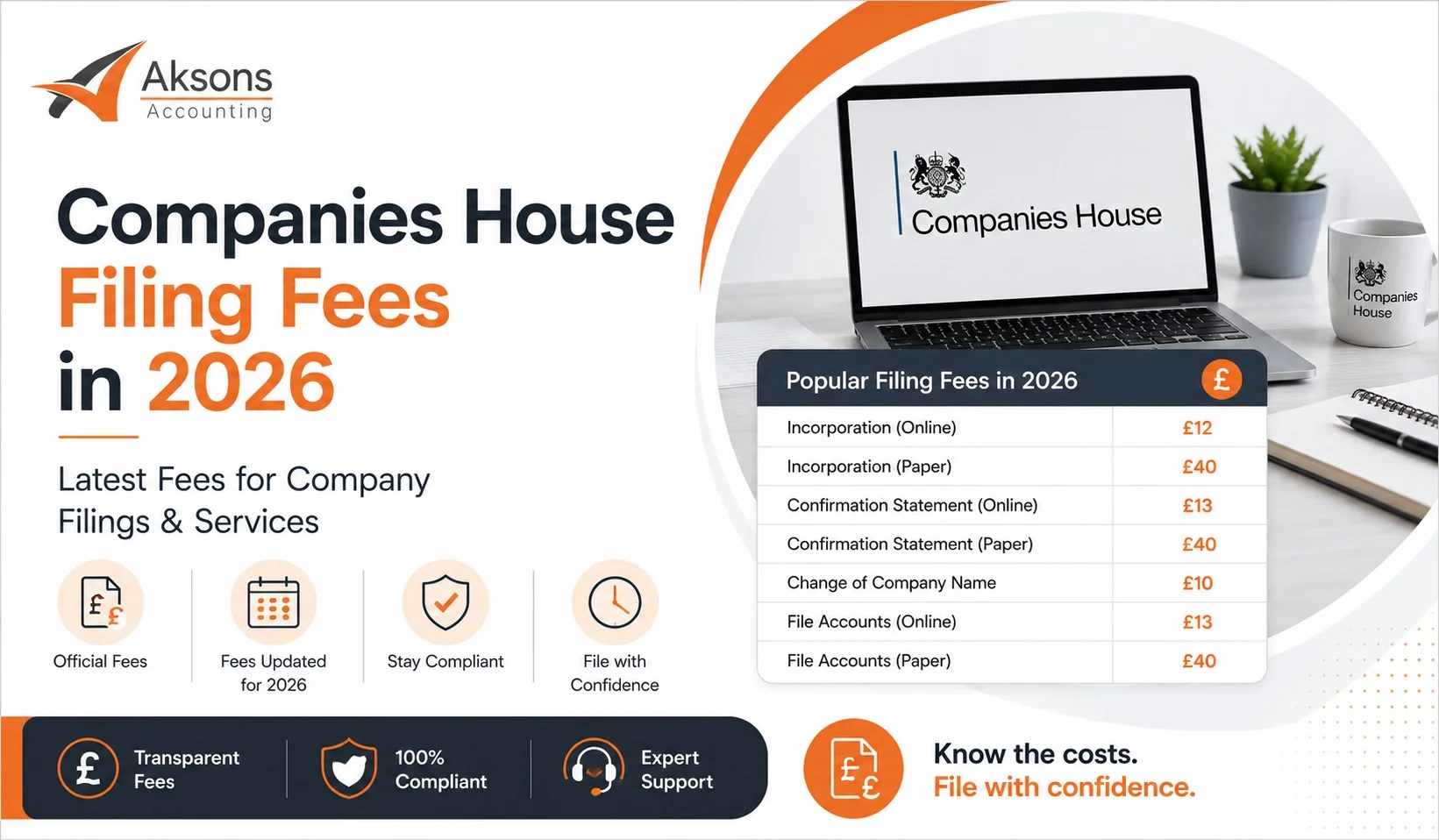
Companies House Filing Fees in 2026
The Real Cost of Late Filing, Compliance Failures, and Poor Company Administration
For many UK business owners, Companies House filing fees look minor on paper.
A confirmation statement fee here. An incorporation charge there. Maybe a late filing penalty once in a while.
But most businesses misunderstand where the real financial risk sits.
The issue is rarely the filing fee itself.
The issue is what poor filing discipline usually reveals underneath:
- weak financial controls
- missed compliance deadlines
- poor director oversight
- inaccurate records
- dormant governance
- reactive accounting processes
Companies House has become significantly stricter in recent years as the UK government increases pressure around economic transparency, fraud prevention, identity verification, and corporate accountability.
That shift matters for SMEs.
Because filing obligations are no longer treated as passive administrative tasks. They are increasingly tied to:
- fraud prevention
- director accountability
- data integrity
- anti money laundering efforts
- corporate transparency reforms
Many businesses still operate as though Companies House is simply a registration database.
It is becoming a far more active regulatory environment.
This guide explains Companies House filing fees in 2026, the hidden costs businesses overlook, how penalties escalate, and why operational discipline matters far more than the fee itself.
What Is Companies House?
Companies House is the UK government body responsible for incorporating and maintaining records for UK companies. It maintains the public register of companies and oversees filing obligations for millions of UK businesses.
Its responsibilities include:
- company incorporation
- annual accounts filing
- confirmation statements
- director information
- PSC records
- company dissolution
- public register maintenance
As of 2025, Companies House maintained records for over 5 million active companies across the UK.
For years, the system was criticised for weak verification controls and abuse by fraudulent entities.
That is now changing rapidly.
Why Companies House Became Stricter
The UK government has been restructuring Companies House powers through the Economic Crime and Corporate Transparency Act 2023.
The goal is straightforward:
- reduce fraudulent companies
- improve identity verification
- increase transparency
- strengthen enforcement powers
Fee increases introduced in 2024 were directly connected to funding expanded enforcement and investigative powers.
That means Companies House is no longer functioning purely as a passive filing registry.
It is increasingly positioned as part of the UK’s anti fraud and economic crime infrastructure.
Businesses ignoring filing responsibilities now face a more aggressive compliance environment than they did historically.
Companies House Filing Fees in 2026
Company Incorporation Fees
| Filing Type | Fee |
| Online incorporation | £50 |
| Postal incorporation | £71 |
| Same day incorporation | £78 |
Online filing remains the cheapest and fastest option for most SMEs.
However, incorporation is usually the smallest long term compliance cost businesses face.
The bigger operational burden comes later through ongoing filing obligations.
Confirmation Statement Filing Fees
Every limited company must file a confirmation statement annually.
This confirms:
- company information
- directors
- PSC records
- registered office details
- shareholding information
Current confirmation statement fees are:
| Filing Method |
Fee |
| Online filing |
£34 |
| Postal filing |
£62 |
These fees increased significantly following Companies House reforms linked to economic crime enforcement funding.
Many SMEs still underestimate confirmation statements because they appear simple.
But inaccurate filings create broader problems:
- director record inconsistencies
- PSC reporting failures
- outdated ownership structures
- incorrect registered office details
That becomes risky during:
- banking reviews
- investment due diligence
- AML checks
- legal disputes
- HMRC investigations
Annual Accounts Filing Penalties
This is where costs escalate quickly.
Companies House imposes automatic late filing penalties for annual accounts.
Private Company Late Filing Penalties
| Delay Period |
Penalty |
| Up to 1 month |
£150 |
| 1 to 3 months |
£375 |
| 3 to 6 months |
£750 |
| More than 6 months |
£1,500 |
For public companies, penalties increase substantially further.
Repeated late filing within consecutive years can result in doubled penalties.
This is where filing discipline matters operationally.
Late accounts often signal:
- poor bookkeeping
- weak internal reporting
- cash flow pressure
- disorganised finance operations
- absent forecasting
The penalty itself is rarely the real problem.
The underlying operational weakness is.
The Hidden Cost of Late Filing
Many SMEs think:
“It’s only a filing penalty.”
But late filing creates secondary consequences businesses often ignore.
1. Damaged Credibility
Banks, lenders, suppliers, and investors frequently review Companies House records.
Repeated late filing signals instability.
Even when the company itself remains operationally healthy.
2. Increased Risk Profiling
Repeated non compliance can trigger increased scrutiny across:
- lenders
- insurers
- compliance providers
- AML systems
- financing applications
Poor filing history becomes part of your business reputation footprint.
3. Director Stress and Operational Chaos
Businesses missing deadlines repeatedly usually operate reactively elsewhere too.
The problem spreads:
- payroll delays
- VAT pressure
- forecasting gaps
- poor reporting visibility
- rushed year end accounts
Late filing is often a symptom.
Not the disease.
Companies House Identity Verification Changes
One of the biggest 2026 developments is the move toward mandatory identity verification for directors and Persons with Significant Control (PSCs).
This reform emerged directly from anti fraud efforts connected to the Economic Crime and Corporate Transparency Act.
The new framework includes Authorised Corporate Service Providers (ACSPs), which can verify identities on behalf of clients.
This signals a major structural shift.
Historically, Companies House relied heavily on submitted information without meaningful verification.
That approach created large scale abuse risks.
The UK government is now attempting to tighten corporate legitimacy controls significantly.
For SMEs, this means:
- more scrutiny
- stronger record expectations
- tighter filing standards
- greater director accountability
Common Filing Mistakes SMEs Make
Treating Companies House as Separate From Financial Management
Many businesses disconnect:
- bookkeeping
- tax planning
- statutory filing
- compliance governance
That separation creates fragmented oversight.
Strong businesses treat filings as part of operational finance management.
Not isolated admin tasks.
Ignoring Dormant Company Obligations
Dormant companies still carry filing responsibilities.
Many directors incorrectly assume inactivity removes compliance duties entirely.
It does not.
Using Outdated Registered Office Addresses
Businesses frequently fail to update:
- registered offices
- director addresses
- PSC details
That creates:
- missed notices
- delayed enforcement communication
- compliance exposure
Leaving Filing Until Deadlines Approach
This creates predictable operational stress every year.
Reactive filing usually leads to:
- rushed accounts
- poor review processes
- avoidable errors
- missed deadlines
The businesses with the cleanest compliance records usually work earlier, not faster.
Companies House and Fraud Prevention
The UK government increasingly views Companies House as a frontline defence against:
- shell companies
- money laundering
- identity fraud
- false directorships
- financial crime
Recent security concerns around Companies House systems also increased scrutiny on data integrity and governance. In 2026, Companies House temporarily suspended online filing after a system vulnerability exposed sensitive director information and raised concerns around unauthorised filings.
This matters because regulatory focus is intensifying.
Businesses should expect:
- tighter controls
- stronger verification
- more enforcement
- higher accountability standards
The direction is clear.
Compliance expectations are rising, not softening.
Why Filing Accuracy Matters More Than Businesses Think
Many SMEs focus entirely on meeting deadlines.
Accuracy matters just as much.
Incorrect filings can create:
- shareholder disputes
- director conflicts
- financing complications
- legal inconsistencies
- AML concerns
Even small administrative inaccuracies can create downstream operational problems later.
Especially during:
- acquisitions
- funding rounds
- disputes
- compliance reviews
The strongest businesses treat statutory records as strategic infrastructure.
Not admin paperwork.
The Role of Accountants in Companies House Compliance
Many SMEs only contact accountants near filing deadlines.
That usually limits strategic value.
A stronger approach is ongoing compliance coordination across:
- bookkeeping
- year end accounts
- Companies House filings
- corporation tax
- director reporting
- governance updates
At Aksons Accounting Services Ltd, one common issue seen across growing SMEs is operational expansion outpacing compliance structure. Businesses add directors, contractors, systems, and entities over time while governance processes remain based on how the company operated years earlier.
That mismatch creates avoidable risk.
Good compliance is rarely about complexity.
It is about consistency.
Practical Companies House Compliance Checklist
Annual Filing Management
- Track filing deadlines centrally
- File accounts early where possible
- Review confirmation statements carefully
Director Oversight
- Keep director details updated
- Verify PSC information regularly
- Monitor resignation and appointment records
Financial Governance
- Maintain organised bookkeeping
- Review year end records proactively
- Avoid reactive filing cycles
Security and Verification
- Monitor Companies House account access
- Use strong authentication controls
- Review filing confirmations carefully
Operational Discipline
- Assign compliance responsibility internally
- Maintain communication with accountants
- Store statutory records securely
Frequently Asked Questions (FAQs)
What are Companies House filing fees?
Companies House filing fees are charges businesses pay for services such as:
- company incorporation
- confirmation statements
- same day filings
- document processing
How much is the confirmation statement fee in 2026?
The confirmation statement fee is:
- £34 for online filing
- £62 for postal filing
What happens if accounts are filed late?
Late filing penalties apply automatically and increase based on delay length.
Penalties for private companies can reach £1,500 for accounts filed more than six months late.
Do dormant companies still need to file accounts?
Yes. Dormant companies still have statutory filing obligations with Companies House.
Can repeated late filing increase penalties?
Yes. Repeated late filing in consecutive years can result in doubled penalties.
Are Companies House fees tax deductible?
In many cases, Companies House filing fees may qualify as allowable business expenses, though businesses should confirm treatment with their accountant.
Why are Companies House fees increasing?
Recent increases are connected to expanded enforcement powers and anti fraud reforms introduced through UK economic crime legislation.
What is a confirmation statement?
A confirmation statement confirms that company information held by Companies House is accurate and up to date.
Can Companies House dissolve a company for non compliance?
Yes. Persistent filing failures can lead to compulsory strike off procedures.
Are Companies House records public?
Yes. Most company information filed with Companies House becomes publicly accessible.
Final Thought
The real cost of Companies House compliance is rarely the filing fee itself.
It is the operational instability poor compliance usually exposes underneath.
Late accounts.
Disorganised records.
Outdated governance.
Weak oversight.
Reactive financial management.
The businesses handling Companies House obligations best in 2026 are usually not the largest companies.
They are the ones treating compliance as part of financial operations rather than annual administrative cleanup.
Because once governance problems become visible publicly, fixing them becomes far more expensive than preventing them earlier.