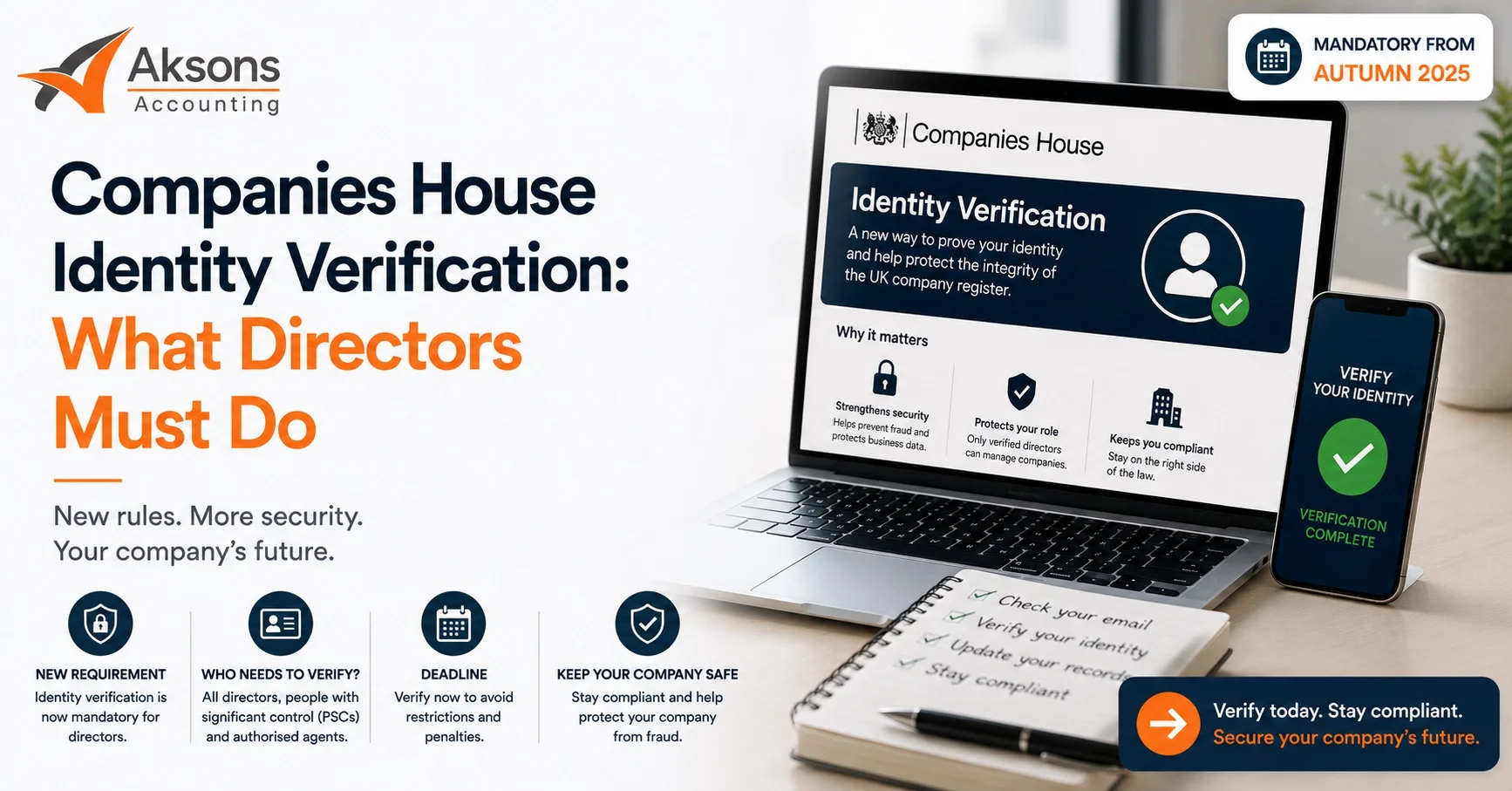
Companies House Identity Verification: What Directors Must Do
Quick Summary: Most guides on Companies House identity verification tell you the rules started on 18 November 2025 and that you have until November 2026, which leaves the majority of directors with entirely the wrong date in their heads. This guide covers what actually determines your position: how your confirmation statement, not the transition period, sets your real deadline; why holding both a directorship and a PSC holding in the same company means two separate submissions rather than one; the 14-day extension service that almost nobody mentions; what happens to your filings and your public record if you miss the date; and which parts of the regime have quietly moved to 2027.
Why 18 November Is the Wrong Date to Have in Your Head
Identity verification became a legal requirement on 18 November 2025 under the Economic Crime and Corporate Transparency Act 2023. Companies House has been unusually direct about what that date is not. Its own guidance states plainly that it is not a deadline. It marks the start of a twelve-month transition period, during which each company reaches its own due date at its own time.
That distinction matters more than any other point in this guide. A director who reads “November 2026” and files it away for later may already have missed a deadline that fell in February. Your obligation is tied to your company’s confirmation statement cycle, and for a large number of companies that trigger has already passed.
The scale of the drift is visible in the numbers. Companies House management information for the April to June 2026 quarter showed that by the end of June, only around 55% of directors had confirmed a verified identity. For PSCs the figure was around 42%. With the transition period closing in November 2026 and Companies House having stated it intends to begin compliance activity once it does, a substantial share of the register is heading towards enforcement without realising it.
What Companies House Identity Verification Actually Is
For most of its history, Companies House operated as a passive register. It recorded what companies told it and published the result, with very little scrutiny of whether the people named existed. That made UK companies attractive to fraudsters.
ECCTA changed the model. Companies House now functions as a gatekeeper rather than a filing cabinet, and identity verification is the mechanism. Every individual who sets up, runs, owns or controls a UK company must have their identity checked against official documents.
Once checked, you receive a Companies House personal code. The code belongs to you rather than to any company. You verify once, and the same code follows you across every UK company role you hold, now and in future.
Who Must Verify
| Role |
Verification required? |
How the code is submitted |
| Directors of UK companies |
Yes |
Through the company’s confirmation statement |
| Directors of overseas companies with a UK establishment |
Yes |
By the anniversary of the establishment’s registration |
| People with significant control (PSCs) |
Yes |
Through the PSC verification service, in a 14-day window |
| Members of an LLP |
Yes |
Same basis as directors |
| Company secretaries and other filers |
Not yet |
Expected no earlier than November 2027 |
| Corporate directors and corporate PSCs |
Not yet |
Date not announced |
Two things worth noting from that table.
The regime is narrower than commonly reported: A good deal of commentary published in early 2026 predicted that people filing on a company’s behalf would need to verify from spring 2026. That timetable has moved. Current guidance puts it no earlier than November 2027, with at least six months’ notice before it takes effect. If you read an article telling you your bookkeeper must verify this year, check its date.
Being a director is not the same as being a PSC: Most owner-managed companies have someone who is both, and that combination creates an obligation many directors miss entirely. It is covered below.
Finding Your Actual Deadline
| Your situation |
Your deadline |
| Director on or before 17 November 2025 |
Before your company’s next confirmation statement falling due after 18 November 2025 |
| Appointed director on or after 18 November 2025 |
Before the appointment is filed |
| Incorporating a new company |
Before incorporation; a code is needed for every director |
| Director of an overseas company with a UK establishment |
By the anniversary of the establishment’s registration |
| PSC who is not a director of that company |
Within the first 14 days of your birth month |
| PSC who is also a director of that company |
Within 14 days starting the day after the confirmation statement date |
| PSC first registered on or after 18 November 2025 |
When added to the register, or within 14 days of being added |
| Backstop for all existing directors and PSCs |
November 2026, when the transition period closes |
Existing Directors: The Confirmation Statement is the Trigger
If you were already a director on 18 November 2025, your deadline is set by your company’s next confirmation statement due after that date. The personal code must be supplied as part of that filing.
A worked example. Your company’s confirmation statement was due on 20 October 2025, before the rules started. The next falls due on 20 October 2026, and that is your deadline, not November. Conversely, if your statement fell due in February 2026, your deadline passed months ago and your filing may already have been blocked.
Check your company’s confirmation statement date on the register before assuming anything.
Directors of More Than One Company
You verify once and receive one personal code, but you must supply it separately for each company. The deadline that binds you is the earliest confirmation statement across all your directorships.
If Company A files in December 2025 and Company B in June 2026, your effective deadline is December 2025. Verifying by June would leave Company A unable to file for six months.
If You are Both a Director and a PSC of the Same Company
This is the trap, and it affects almost every owner-managed limited company.
Holding both roles means two separate submissions, not one. As a director, you provide the code in the confirmation statement. As a PSC, you must provide it separately through the PSC identity verification service, within a 14-day period that begins the day after the company’s confirmation statement date.
Critically, filing your confirmation statement early does not shift that 14-day window. Many directors submit the statement, see it accepted, and assume the whole obligation is discharged. It is not. The PSC submission is a distinct filing with its own deadline.
You can check the exact dates of your 14-day period on the Companies House register.
The Two Verification Routes
|
GOV.UK One Login |
Authorised Corporate Service Provider |
| Cost |
Free |
Usually chargeable |
| Who provides it |
Companies House directly |
Accountants, solicitors, formation agents, chartered secretaries |
| Typical time |
Under 15 minutes with a biometric passport |
Depends on the firm |
| Methods |
One Login app, online security questions, or Post Office |
Firm’s own verified process |
| Best suited to |
UK directors with standard photo ID |
Overseas directors, non-standard documents, larger boards |
| Standard applied |
Statutory standard |
The same statutory standard |
Both routes produce an identical outcome and the same personal code. ACSPs must meet the same level of assurance as Companies House itself.
Three practical points on the free route. You must enter your photo ID details on GOV.UK before attending a Post Office; you cannot simply turn up with documents. Your verified identity attaches to your GOV.UK One Login, and an email address can only be used to verify one person, so spouses who are co-directors and share an inbox will need separate accounts. And over a million people had verified through One Login before the rules even became mandatory, so the service is well tested at volume.
If you already use an agent to file at Companies House, ask whether they are ACSP-registered. It is a reasonable question and any competent firm will answer it directly.
Your Personal Code and What to Do With It
Three things matter once you have it.
Record it somewhere permanent: You need it for every confirmation statement and every new company role. Retrieving a lost code is possible but tedious.
It is personal, not corporate: One code covers every directorship, PSC holding and LLP membership. You never need a second one, but you do need to submit it against each role.
Treat it as sensitive: Share it only with professionals you trust to file on your behalf, such as your accountant. Companies House has warned specifically against selling or handing over your identity to let others run companies in your name, because you remain legally responsible for what is done under it.
What Happens If You Miss Your Deadline
The consequences compound, and they begin immediately.
Your filings stop: A confirmation statement will not be accepted unless every director on it has verified and supplied a code. The submission is rejected outright. You also cannot incorporate a new company or be appointed to an existing one.
Your company goes overdue: A rejected confirmation statement produces an overdue filing. That status is public and credit reference agencies pick it up, which affects supplier credit and lending.
Your name is annotated on the public register: Companies House has confirmed it will display a note against the name of anyone who fails to comply. Anyone searching your company can see it.
You may be committing a criminal offence: Continuing to act as a director once your verification deadline has passed is an offence under section 167M of the Companies Act 2006, and the company can also be in breach for failing to correct the position. This is not a late-filing technicality.
Financial penalties follow: Companies House can impose civil penalties where non-compliance persists, without going to court.
Serious cases escalate: Prosecution becomes more likely where there are three or more offences within five years, where fraudulent documents have been used, or where there is other evidence of criminal activity. Companies House can also refer matters to the Insolvency Service and share information with law enforcement. Director disqualification and company strike-off sit at the end of that road.
The Extension Almost Nobody Mentions
If you are a PSC and cannot provide your verification details in time, Companies House operates a service to request a 14-day extension. It is genuinely useful and it is barely covered anywhere.
One condition matters absolutely: you must request it before your verification deadline has passed. Once the window closes, the extension is no longer available to you. If you can see a problem coming, act on it while the deadline is still in front of you.
What Catches Directors Out
Most verifications go through cleanly. The failures cluster around a handful of causes.
Mismatched date of birth: The most common single failure. If the month and year recorded against you on the register do not match your identity document, verification will not connect. Check the register entry first and correct it if wrong.
Name variations: An anglicised name, a maiden name or a shortened first name on the register will not match a passport that says otherwise.
Shared email addresses: Two co-directors using the same email cannot both verify through One Login. Each person needs their own.
Assuming the confirmation statement covered everything: If you are also a PSC, it did not.
Assuming your accountant has handled it: They can file for you, but they cannot verify your identity unless they are an ACSP and you have actively engaged them to do it.
Overseas directors: Non-UK documents and time zones both slow things down. Start earlier than feels necessary and consider an ACSP.
Waiting for November 2026: For most companies the real deadline is the next confirmation statement, which arrives well before the transition period closes.
Putting It Into Practice: A Quick Checklist
- Looked up your company on the Companies House register and noted the next confirmation statement date
- Repeated that for every directorship you hold and taken the earliest date
- Checked whether you are also a PSC of any of those companies
- If so, checked the dates of your separate 14-day PSC window on the register
- Confirmed your recorded name and date of birth match your passport or driving licence exactly
- Verified through GOV.UK One Login, or confirmed your accountant is ACSP-registered
- Saved your personal code somewhere permanent
- Supplied the code against every role you hold, not just one
- Chased co-directors and PSCs, since one unverified person blocks the whole statement
- Requested a 14-day extension if a PSC deadline is at risk, before it passes
Key Takeaways
- 18 November 2025 started a twelve-month transition period; it was never a universal deadline.
- Your real deadline as an existing director is your company’s next confirmation statement due after that date.
- Directors of multiple companies verify once but must supply the code for each company, bound by the earliest statement date.
- Anyone who is both a director and a PSC of the same company must make two separate submissions with different deadlines.
- PSCs facing a missed deadline can request a 14-day extension, but only before the deadline passes.
- Non-compliance blocks filings, marks the public register, and can constitute a criminal offence under section 167M.
- Verification for company secretaries and other filers has moved to no earlier than November 2027.
-
Frequently Asked Questions
What is the deadline for Companies House identity verification?
There is no single deadline. For existing directors it is your company’s next confirmation statement falling due after 18 November 2025. The transition period closes in November 2026, which acts as a backstop, but most directors reach their own deadline well before then.
I am a director of three companies. Do I verify three times?
No. You verify once and receive one personal code. However, you must supply that code against each company separately, and your effective deadline is the earliest confirmation statement across all three.
I am both a director and the sole shareholder. Is one submission enough?
No, and this catches a lot of people. As a director you provide the code in the confirmation statement. As a PSC you provide it separately through the PSC verification service, within 14 days starting the day after the confirmation statement date. Filing the statement early does not move that window.
How long does verification take and does it cost anything?
Verifying directly through GOV.UK One Login is free and most people with a biometric passport complete it in under fifteen minutes. Verifying through an Authorised Corporate Service Provider usually carries a fee but produces the same result.
Can I get more time if I am going to miss my deadline?
PSCs can request a 14-day extension through the Companies House service, but only before the deadline has passed. Once the window closes the option is gone.
What happens if one of my co-directors has not been verified?
The confirmation statement cannot be filed. Verification is required for every director on the statement, so a single unverified person blocks the filing for the whole company.
Does my accountant need to verify their identity too?
Not yet in their capacity as a filer. Verification for people who file at Companies House is expected no earlier than November 2027, with at least six months’ notice. If your accountant verifies your identity on your behalf, however, they must be registered as an ACSP.
Conclusion
Companies House identity verification is one of the few compliance obligations where the process itself can take only minutes, but failing to complete it can lead to blocked filings, a marked public record and potential criminal liability. The key is not simply completing verification, but understanding your actual deadline, checking every directorship and PSC role, and making sure each required submission is completed correctly.
If you are unsure whether you have completed your Companies House identity verification, or you need help checking deadlines across multiple companies, Aksons Accounting can help. Our team can review your company and PSC positions, identify what still needs to be done, and guide you through the requirements.
Need help with Companies House compliance? Contact Aksons Accounting today to check your identity verification status and make sure your company filings stay on track.