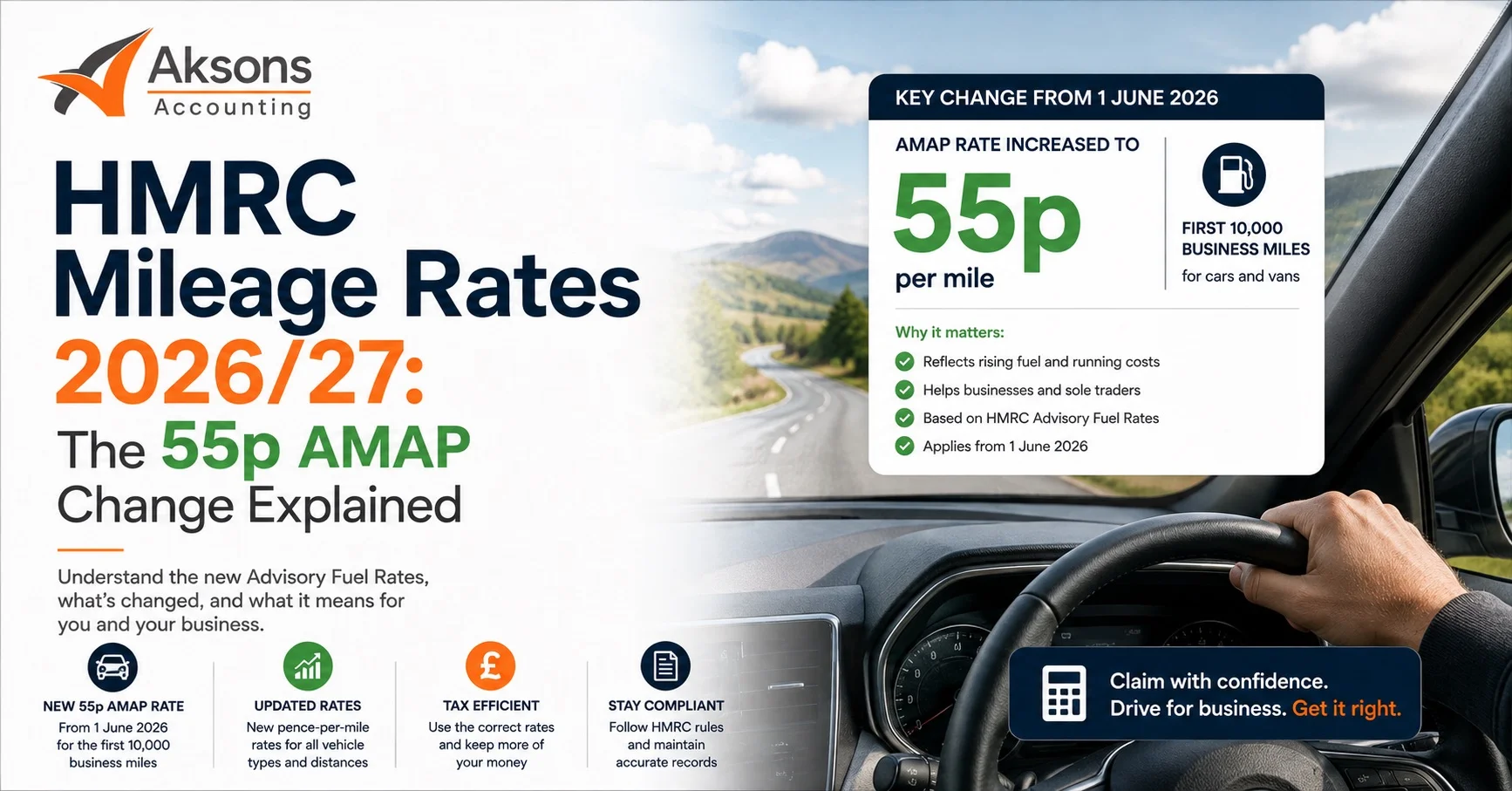
HMRC Mileage Rates 2026/27: The 55p AMAP Change Explained
Quick Summary: Most articles on HMRC mileage rates simply restate the new 55p figure and stop there, which leaves the expensive questions unanswered. This guide covers what actually determines whether you get the money: how the 55p and 25p bands interact across a tax year, why AMAP rates and company car mileage rates are entirely different systems that people routinely confuse, how the claim mechanism changes depending on whether you are a sole trader, a director or an employee, what to do if you have been reimbursed at the old 45p rate since April, and which journeys genuinely qualify as business mileage in the first place.
Why the 55p Figure on Its Own Is Not Enough
For fifteen years, the HMRC mileage rate did not move. It sat at 45p per mile while fuel, insurance and servicing costs all climbed around it, and every professional body that raised the issue was told the rate remained under review.
That changed on 21 May 2026, when the Chancellor confirmed that the Approved Mileage Allowance Payment for cars and vans would rise from 45p to 55p for the first 10,000 business miles. The increase was backdated to 6 April 2026, so it covers every qualifying mile already driven in the current tax year.
Knowing the number is the easy part. The costly errors happen elsewhere: applying the wrong rate to a company car, missing the second band above 10,000 miles, failing to claim the shortfall when an employer reimburses below the approved rate, or keeping records that will not survive an enquiry. This guide works through each of those in turn.
HMRC Mileage Rates 2026/27 in Full
| Vehicle | Rate for 2026/27 | Threshold | Changed this year? |
| Cars and vans, first 10,000 business miles | 55p per mile | Resets each 6 April | Yes, up from 45p |
| Cars and vans, miles above 10,000 | 25p per mile | — | No |
| Motorcycles | 24p per mile | No threshold | No |
| Bicycles | 20p per mile | No threshold | No |
| Passenger payment (cars only) | 5p per mile, per passenger | No threshold | No |
Only the first band moved. It is a 22% uplift and the first change to Approved Mileage Allowance Payments since the 2011/12 tax year.
Three points that catch people out:
The 10,000-mile threshold resets on 6 April: It is a tax year figure rather than a rolling twelve months, and it applies per person, not per vehicle. If you use two cars during the year, the miles are added together.
There is no separate rate for electric vehicles: If you use your own EV for business, you claim the same 55p and 25p as a petrol or diesel driver. Hybrids are treated identically. The running costs look very different, but the approved rate does not distinguish between them.
The passenger payment only covers fellow employees: Carrying a colleague on a business journey adds 5p per mile per passenger, tax free. Carrying a client, a supplier or a family member does not qualify.
What the Increase Is Actually Worth
The arithmetic is straightforward, and the amounts are larger than most people expect.
| Annual business miles |
Claim at 2026/27 rates |
Claim at old 45p rate |
You gain |
| 5,000 |
£2,750 |
£2,250 |
£500 |
| 8,000 |
£4,400 |
£3,600 |
£800 |
| 12,000 |
£6,000 |
£5,000 |
£1,000 |
| 20,000 |
£8,000 |
£7,000 |
£1,000 |
The 12,000-mile calculation works as (10,000 × 55p) + (2,000 × 25p) = £5,500 + £500 = £6,000. Note that the gain plateaus at £1,000 once you pass 10,000 miles, because the second band did not change.
What that £1,000 is worth in cash depends on how you trade. For a limited company director, the reimbursement leaves the company free of income tax and National Insurance, and the company still gets a corporation tax deduction on it. For a sole trader, it is an additional deduction against trading profit, so the benefit is the extra deduction multiplied by your marginal rate.
AMAP Rates and Company Car Mileage Are Not the Same System
This is the single most common and most expensive error in this area, and it produces incorrect claims in both directions.
| | Approved Mileage Allowance Payments (AMAP) | Advisory Fuel Rates (AFR) |
| Applies to | Your own vehicle used for business | Company-provided cars only |
| Covers | Fuel, insurance, road tax, servicing, tyres, depreciation | Fuel only |
| 2026/27 rate | 55p / 25p for cars and vans | Varies by fuel type and engine size |
| How often it changes | Rarely, last change was 2011/12 | Quarterly |
| Used by | Sole traders, directors using a personal car, employees | Employers reimbursing company car fuel |
Applying 55p to a company car is wrong and creates a taxable benefit. Applying an advisory fuel rate to a personal car short-changes you by roughly 40p a mile.
Advisory Fuel Rates from 1 September 2026
HMRC reviews these quarterly, on 1 March, 1 June, 1 September and 1 December.
| Engine size | Petrol | Diesel | LPG |
| 1400cc or less (petrol and LPG) | 14p | — | 11p |
| 1600cc or less (diesel) | — | 15p | — |
| 1401cc to 2000cc (petrol and LPG) | 17p | — | 13p |
| 1601cc to 2000cc (diesel) | — | 16p | — |
| Over 2000cc | 27p | 22p | 20p |
For fully electric company cars, the advisory electric rate is 7p per mile for home charging and 15p per mile for public charging. Where a car is charged in both places, apportion the mileage on a fair and reasonable basis.
Two practical notes. Hybrids count as petrol or diesel for advisory fuel rate purposes, not electric. And HMRC allows you to keep using the previous quarter’s rates for up to one month after new ones take effect, which gives payroll some breathing room each quarter.
Because these figures move every three months, check GOV.UK before applying them rather than relying on a rate you set earlier in the year.
How to Claim, Depending on How You Trade
The rates are identical across all three routes. The mechanism is not.
Sole traders
You have two options for each vehicle, and you must commit to one.
Simplified expenses use the flat 55p and 25p rates. It rolls fuel, insurance, servicing, repairs and depreciation into a single figure, entered as one number on your Self Assessment return.
Actual costs means totting up every running cost and claiming the business proportion, alongside capital allowances on the vehicle.
Once you choose the mileage method for a particular vehicle, you must stick with it for as long as that vehicle stays in the business. You cannot alternate between tax years. Simplified expenses generally favour lower-mileage, older or more economical vehicles; actual costs tend to win for high-mileage, newer or thirstier ones. You can use different methods for different vehicles.
Limited company directors
You cannot claim mileage on your personal tax return. Instead, you submit a mileage claim to your own company and the company reimburses you from company funds at 55p and 25p.
The payment is tax free in your hands and deductible for the company. Keep it clean: a proper mileage log, a claim form or expense entry, and payment through the company bank account rather than netted against a director’s loan at year end. Anything paid above 55p per mile becomes taxable and must go through payroll or onto a P11D.
Employees and contractors reimbursed below the approved rate
If your employer or end client pays less than the HMRC rate, you can claim tax relief on the difference. This is Mileage Allowance Relief.
Say you drive 10,000 business miles and are reimbursed at 45p. The approved amount is £5,500 and you received £4,500, leaving a £1,000 shortfall. A basic-rate taxpayer recovers £200 on that; a higher-rate taxpayer recovers £400.
Claim through your Self Assessment return, or on form P87 if your total employment expenses are under £2,500 and you do not file a return.
This is particularly live right now. Many employers reimbursed at 45p through April and May 2026 before the increase was announced. If yours has not issued a backdated top-up, the shortfall is claimable.
Which Journeys Actually Qualify
The rate is only worth something if the journey counts.
Qualifying journeys include travel to a client, supplier or site, travel between two workplaces, and travel to a temporary workplace. That last category matters enormously for construction subcontractors and contractors moving between sites, and it is one of the most under-claimed costs we see.
Non-qualifying journeys include ordinary commuting between home and a permanent workplace, and any personal travel. Stopping at a client on the way to the office does not convert the commute into a business journey.
If you work from home and your home is genuinely your business base, journeys from home to clients generally qualify. The permanent-versus-temporary workplace distinction is fact-specific, so if you spend extended periods at one client’s premises, check the position rather than assuming it.
The Records HMRC Expects
A mileage claim without a log is a claim waiting to be disallowed. For each journey, record:
- The date
- Starting point and destination
- The business purpose
- Miles driven
A spreadsheet is acceptable. A tracking app is easier. Either way, keep it as you go rather than reconstructing twelve months of driving the night before your return is due.
If you fall within Making Tax Digital for Income Tax, your underlying records need to withstand the same scrutiny as everything else in your quarterly submissions, so this is a sensible moment to move from receipts in a drawer to something structured.
Putting It Into Practice: A Quick Checklist
Work through this before your next claim or payroll run:
- Confirmed the rate actually used since 6 April 2026 (correct it if it is still 45p)
- Checked whether cumulative business miles have passed 10,000 this tax year
- Confirmed you are using AMAP rates for personal vehicles and advisory fuel rates for company cars
- Updated expenses policy, payroll or expense software to 55p
- Considered a backdated top-up for anyone reimbursed at 45p since April
- Calculated any Mileage Allowance Relief owed where reimbursement fell below 55p
- Claimed the 5p passenger payment where colleagues travelled with you
- Verified that no fuel, insurance or servicing has been claimed on top of the mileage rate
- Got a contemporaneous mileage log running with date, route, purpose and distance
- Diarised the next advisory fuel rate review if you run company cars
Key Takeaways
- The HMRC mileage rate for cars and vans is 55p per mile for the first 10,000 business miles in 2026/27, and 25p thereafter.
- The change was announced on 21 May 2026 and backdated to 6 April 2026, so it applies to miles already driven.
- Motorcycle, bicycle and passenger payment rates are unchanged, and there is no separate rate for electric vehicles.
- AMAP rates and advisory fuel rates are separate systems; applying the wrong one creates either a tax charge or an under-claim.
- Sole traders, directors and employees all use the same rates but claim through entirely different mechanisms.
- Anyone reimbursed at 45p since April can claim the 10p shortfall as Mileage Allowance Relief.
- The mileage rate covers all running costs, so fuel and insurance cannot be claimed separately on the same vehicle.
Frequently Asked Questions
What is the HMRC mileage rate for 2026/27?
For cars and vans it is 55p per mile for the first 10,000 business miles in the tax year, then 25p per mile after that. Motorcycles are 24p and bicycles 20p, with no mileage threshold on either.
When did the 45p rate change, and does it apply to miles I have already driven?
The increase was confirmed on 21 May 2026 and backdated to 6 April 2026, the start of the tax year. It applies to every qualifying mile driven in 2026/27, including those before the announcement.
Can I claim 55p per mile for an electric car?
Yes, if it is your own vehicle. There is no separate AMAP rate for electric cars, so personally owned EVs and hybrids use the same 55p and 25p rates as petrol and diesel. Company electric cars are different and use the advisory electric rate instead.
What is the difference between AMAP rates and advisory fuel rates?
AMAP rates apply to your own vehicle and cover all running costs in one figure. Advisory fuel rates apply only to company cars and cover fuel alone, because the company already bears the other costs. They are reviewed quarterly.
My employer only pays 45p. Can I claim the difference?
Yes. The shortfall is claimable as Mileage Allowance Relief, either through Self Assessment or on form P87 if your total employment expenses are under £2,500 and you do not file a return.
Does the 10,000-mile threshold reset each tax year?
It does, on 6 April. It also applies per person rather than per vehicle, so miles across two cars are added together.
Can I claim mileage and fuel receipts on the same vehicle?
No. The 55p rate is designed to cover fuel, insurance, road tax, servicing and depreciation in one figure. Claiming those costs separately on top of the mileage rate will be disallowed.
Conclusion
The rise to 55p is the first meaningful improvement to business travel relief in fifteen years, and for anyone regularly on the road, it could make a noticeable difference to your annual tax position. But getting the full benefit depends on using the correct rate, claiming only eligible business journeys, and keeping accurate mileage records.
If you are unsure whether you have applied the HMRC mileage rates 2026/27 correctly, Aksons Accounting can help. Whether you need to check a mileage claim, calculate Mileage Allowance Relief, or correct payments made at the old 45p rate, our team can review your figures and explain what you should claim.
Need help with your 2026/27 mileage claim? Contact Aksons Accounting today for professional advice and make sure you are claiming the mileage relief you are entitled to.